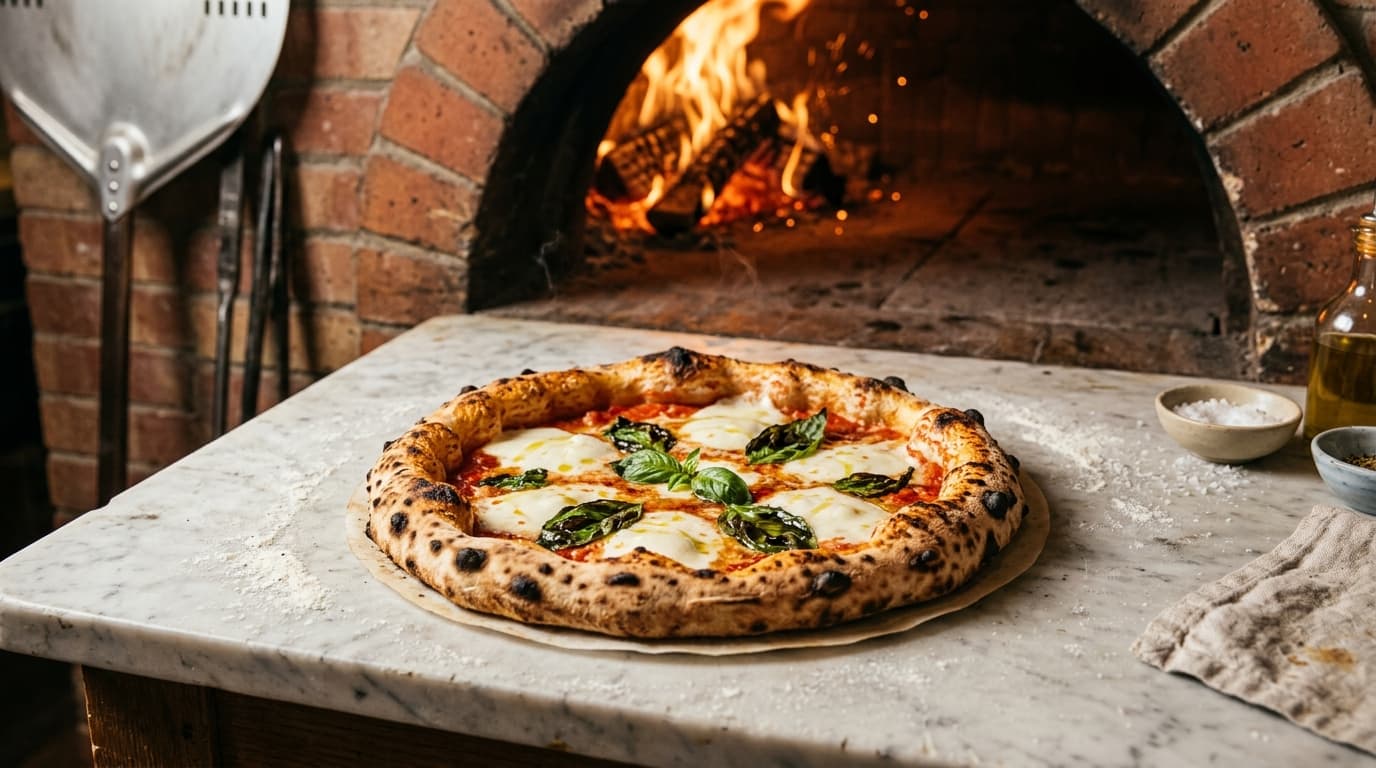
The formula
- Makes
- 4 × 250 g balls
- Bake at
- 950°F
- Hands-on
- 25 min
- Total
- 8h 27
| Ingredient | Weight | Baker’s |
|---|---|---|
| 00 flourFine-milled, roughly 12–13% protein | 625 g | 100% |
| WaterCool, around 18°C | 356 g | 57% |
| Fine sea salt | 18 g | 2.9% |
| Instant dry yeastOr 1.2 g fresh yeast | 0.4 g | 0.06% |
Scale it to any batch with the dough calculator — it uses the same percentages.
Method
- 01
Dissolve the salt in the water. Salt first is the AVPN order, and it keeps the yeast from meeting undiluted salt later.
2 minutes
- 02
Add about a tenth of the flour and stir to a slurry, then the yeast, then the rest of the flour a handful at a time until it comes together as a shaggy mass.
8 minutes
- 03
Knead until smooth and the surface no longer tears when you stretch a corner. Roughly 10 minutes by hand.
10 minutes
- 04
Cover and rest at room temperature for two hours. This is the bulk ferment; the dough will relax more than it rises.
2 hours
- 05
Divide into four 250g pieces and shape each into a tight ball. Rest them covered, spaced apart so they do not fuse as they spread.
5 minutes
- 06
Prove the balls for a further six hours at room temperature. They are ready when a fingertip leaves a dent that fills back slowly.
6 hours
- 07
Open each ball by hand from the centre outwards, leaving the outer inch untouched so it can puff into the cornicione. Never a rolling pin.
2 minutes
- 08
Bake at 950°F for 60 to 90 seconds, turning once. The base should be set and spotted before the top browns.
2 minutes
Where these numbers come from
The AVPN disciplinare does not give a recipe. It gives ranges, per litre of water: 1.6–1.8kg of flour, 40–60g of salt, and 0.1–3g of fresh yeast.
That is a wide space — the flour range alone spans 56–62% hydration. So the numbers above are a choice inside it rather than a figure handed down: we take 1.75kg of flour, 50g of salt and 3g of fresh yeast, which is 57% hydration, 2.9% salt and 0.17% fresh yeast. Every one of those sits within the published range, and 0.17% fresh converts to about 0.06% instant, which is the figure in the table above.
Anyone quoting a single "AVPN hydration" number is quoting their own preference with someone else's authority attached.
We have not baked this in our own oven. The arithmetic is arithmetic, and the specification is published; what happens in your kitchen depends on your flour, your water and how hot your oven actually gets rather than what it claims.
The two rests are doing different jobs
The bulk ferment relaxes the gluten you just built. The dough will look like it has barely risen, and that is correct — you are waiting for extensibility, not volume.
The ball proof is where the gas arrives. Six hours is a starting point at ordinary room temperature; a warm kitchen will get there faster and a cold one slower, which is why the fingertip test matters more than the clock.
Scaling it
Every quantity here is a percentage of the flour weight, so the formula scales without changing. Doubling the flour doubles everything else.
The dough calculator does the inversion the other way — you say how many balls and how heavy, it returns the grams. Its Neapolitan preset is these exact percentages, so the two cannot disagree.
Gear mentioned

Ooni Koda 16
Gas-only and deliberately simple. Turn it on, wait, cook — no fire to manage.
- Max temperature
- 950°F (500°C)
- Max pizza size
- 16 in
- Stone thickness
- 0.6 in (15 mm) cordierite

Gozney Roccbox
The portable one. Retractable legs and a silicone jacket you can stand next to.
- Max temperature
- 950°F (500°C)
- Max pizza size
- 12 in
- Time to temperature
- Under 20 min to 700°F (not to its 950°F maximum)

Solo Stove Pi Prime
Propane-only portable 12-inch pizza oven with Demi-Dome heat redirection and front-facing dial control.
- Pizza capacity
- 12-inch pizza capacity
- Heat-up time
- Reaches 950°F in approximately 15 minutes
- Design
- Demi-Dome round construction with front-facing flame dial
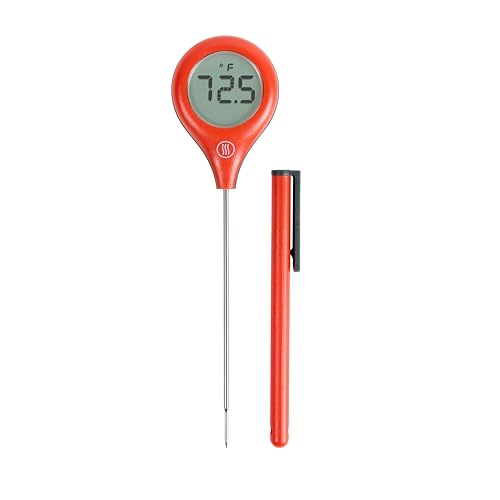
ThermoWorks ThermoPop 2
The middle of the thermometer ladder. Publishes its accuracy like the Thermapen, at a fraction of it.
- Accuracy
- ±1°F in key cooking ranges
- Response time
- 2-3 seconds
- Calibration
- NIST-traceable certificate included
Common questions
- Why is the yeast quantity so small?
- Because the ferment is long. 0.4g of instant yeast across eight hours does the same work a larger quantity would do in one, and a slow rise builds flavour a fast one cannot. It is also below what most kitchen scales resolve — see the note below.
- Can I make this in a domestic oven?
- Not as written. This formula assumes a 950°F bake lasting 60 to 90 seconds. A kitchen oven at 500°F takes several minutes, and a 57% hydration dough spends that time drying rather than puffing. Use a New York formula instead.
- What if I want a different number of pizzas?
- Keep the percentages and change the flour weight. Our dough calculator inverts it for you — enter the number of balls and the ball weight and it returns the exact grams, using these same figures as its Neapolitan preset.
- Is 00 flour essential?
- It is what the AVPN specification calls for, and its fine milling suits a very fast bake. Bread flour works but browns differently over 60 seconds. Protein content matters more than the label — around 12 to 13% is the range to look for.
Sources
Gear from this recipe, compared
Ooni Koda 16 vs Gozney Roccbox
Also covers the Ooni Koda 16 and the Gozney Roccbox.
Solo Stove Pi Prime vs Gozney Roccbox
Also covers the Solo Stove Pi Prime and the Gozney Roccbox.
Why a 950°F Oven Still Gives You a Pale Base
Also covers the Ooni Koda 16 and the Gozney Roccbox.
The Best Outdoor Pizza Ovens, Compared on Published Specs
Also covers the Ooni Koda 16 and the Gozney Roccbox.