Guide
Why a 950°F Oven Still Gives You a Pale Base
Mike Ross · How we research · Updated 2026-08-29 · 4 min read
Two numbers, and you are reading the wrong one
The thermometer on the oven, or the infrared gun pointed into the dome, is telling you about air. The bottom of your pizza never touches air. It sits on stone, and stone heats on a completely different schedule.
Fire raises air temperature almost immediately. A dense cordierite floor absorbs heat slowly and keeps absorbing it long after the air has stopped climbing. So there is a window — often a long one — where the oven is genuinely at temperature and the floor is not.
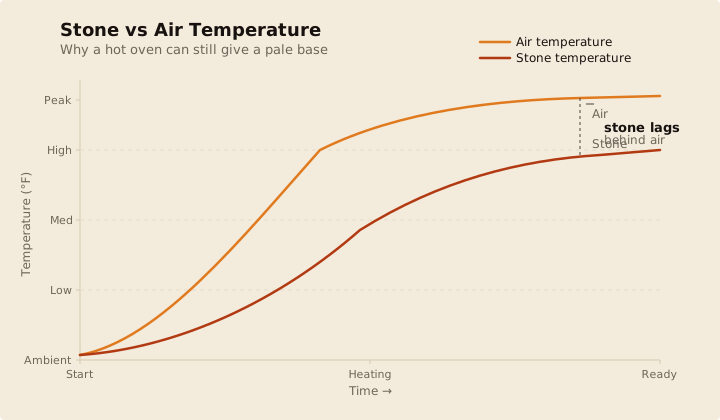
Cook in that window and you get exactly the result people describe as inexplicable: a cornicione that is puffed and spotted, over a base that is white and floppy.
Top and bottom are cooked by different physics
This is the part that makes it click, and it is well established rather than folklore.
Greg Blonder's analysis of wood-fired ovens describes the base as heated mostly by conduction — direct contact with the stone — and the top mostly by radiation from the flame and the dome. Two mechanisms, two rates, one pizza.
The practical consequence is that a great bake is the two mechanisms arriving at the same time. Blonder puts it plainly: to get a base as crisp as the top, you have to find the right position in the oven along with the right dough hydration and bubble density, so the two heating mechanisms are in sync.
That is why moving the pizza around the oven works, and why the same dough behaves differently in two ovens rated to the same temperature.
There is a second, smaller trap
Blonder also points out something that catches people mid-bake: once the pizza puffs, shrinks, or gets nudged with the peel, an air gap can open between the stone and the dough. That gap is an insulator, and it dramatically slows the heat flowing into the base.
So a base can start cooking well and then stop, for reasons that have nothing to do with the oven's temperature at all. If you are launching and then immediately shuffling the pizza, you are working against yourself.
What to actually do
Preheat past the manufacturer's number. Gozney publishes under 20 minutes for the Roccbox — and reading the wording closely, that is 20 minutes to 700°F, not to the 950°F the same page advertises. This is the whole argument of this page in one sentence: a time-to-temperature figure names a temperature, and it is rarely the headline one. Read it as the earliest the oven could be ready, not the moment the floor is. Another ten or fifteen minutes costs you nothing but gas.
Measure the stone, not the air. An infrared thermometer pointed at the spot where the pizza will land tells you the number that matters. A probe thermometer cannot — it is built for air and food, not hard surfaces.
Let the floor recover between pizzas. Every cold base you launch pulls heat out of the stone. Thicker stone helps: Ooni lists 0.6 inches of cordierite on the Koda 16, and mass is what buys you the second and third pizza.
The one-line version
The oven being hot and the floor being hot are two different events, and the second one happens later than you think.
Gear mentioned

Ooni Koda 16
Gas-only and deliberately simple. Turn it on, wait, cook — no fire to manage.
- Max temperature
- 950°F (500°C)
- Max pizza size
- 16 in
- Stone thickness
- 0.6 in (15 mm) cordierite

Gozney Roccbox
The portable one. Retractable legs and a silicone jacket you can stand next to.
- Max temperature
- 950°F (500°C)
- Max pizza size
- 12 in
- Time to temperature
- Under 20 min to 700°F (not to its 950°F maximum)
Common questions
- Why is the bottom of my pizza pale but the top is burnt?
- Because the two surfaces are cooked by different mechanisms. The top is heated mostly by radiation from the flame and dome; the base is heated by conduction from the stone. If the stone has not saturated, the top finishes long before the bottom colours.
- How long should I preheat a pizza oven?
- Longer than the manufacturer's time-to-temperature figure, which describes the oven reaching an air temperature rather than the stone saturating. Gozney's figure for the Roccbox is under 20 minutes to 700°F — not to its 950°F maximum. Treat numbers like that as the earliest the oven could be ready, not the point the floor is.
- How do I measure stone temperature?
- An infrared thermometer pointed at the cooking surface. A probe thermometer measures air or food, not a hard surface, so it will not tell you what you need to know here. Point it where the pizza will actually sit.
- Does a thicker stone help?
- It holds more heat, so it drops less when a cold base lands on it and recovers faster between pizzas. It also takes longer to saturate in the first place. Ooni lists a 0.6 inch cordierite stone for the Koda 16.
Sources
Every figure on this page came from one of these. We have not tested this equipment ourselves — how we research.
Compared elsewhere
Ooni Koda 16 vs Gozney Roccbox
Also covers the Ooni Koda 16 and the Gozney Roccbox.
Neapolitan Pizza Dough
Also covers the Ooni Koda 16 and the Gozney Roccbox.
The Best Outdoor Pizza Ovens, Compared on Published Specs
Also covers the Ooni Koda 16 and the Gozney Roccbox.
Gozney Arc XL vs Ooni Koda 16
Also covers the Ooni Koda 16.