smokers grills
Gas vs Charcoal Grill: What the Published Specs Actually Say
Mike Ross · How we research · Updated 2026-09-06 · 5 min read
The picks
Product image pending
Best if you cook on weeknights and have the patio width for it
Weber Spirit E-325
Three burners with a two-burner Sear Zone, porcelain-enameled cast-iron grates, and Snap-Jet ignition. The baseline backyard gas grill.
- Burner output
- 31,000 BTU-per-hour input across 3 stainless steel burners
- Sear Zone
- 2 Boost Burners, which Weber says unleash 40% more power in the Sear Zone
- Cooking area
- 450 sq in total (360 sq in primary, 90 sq in warming rack)
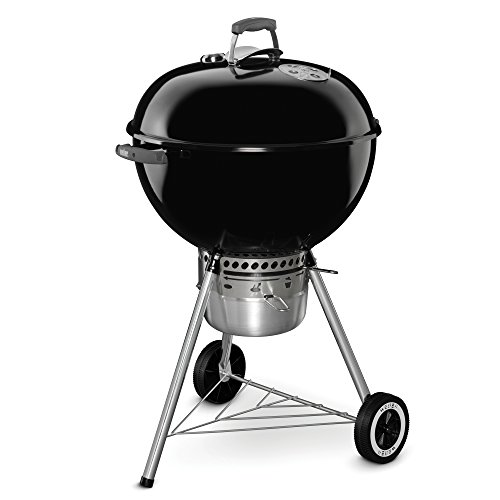
Best if space is tight — same primary grate, half the footprint
Weber Original Kettle Premium 22"
The default charcoal grill, and a competent smoker with the vents half shut.
- Cooking area
- 363 sq in
- Diameter
- 22 in
- Dimensions
- 39.5 in H × 22.5 in W × 27 in D, lid closed
Compared
| Spec | WeberSpirit E-325 | WeberOriginal Kettle Premium 22" |
|---|---|---|
| Price band | ||
| Burner output | 31,000 BTU-per-hour input across 3 stainless steel burners | — |
| Sear Zone | 2 Boost Burners, which Weber says unleash 40% more power in the Sear Zone | — |
| Cooking area | 450 sq in total (360 sq in primary, 90 sq in warming rack) | 363 sq in |
| Dimensions | 46.20" H x 48.30" W x 26.60" D (lid closed) | 39.5 in H × 22.5 in W × 27 in D, lid closed |
| Cooking grates | Porcelain-enameled, cast-iron cooking grates | — |
| Warranty | 10 years cookbox, lid assembly and stainless steel burner tubes, no rust through or burn through; 5 years grates and Flavorizer bars | 10 years on bowl and lid, no rust or burn through |
| Diameter | — | 22 in |
| Cooking grate | — | Plated steel, hinged |
| Where to buy | Check current price on Amazon | Check current price on Amazon |
Almost every gas-versus-charcoal comparison opens with temperature. Charcoal sears at 700°F, the story goes, while gas tops out somewhere around 550°F.
Weber publishes neither number.
We went through the specification pages for both of the grills below — the gas Spirit E-325 and the charcoal Original Kettle Premium 22 — and there is no maximum temperature on either. Burner output, cooking area, dimensions, warranty terms, grate material: all published. Peak grate temperature: absent, on both. Any article quoting one is quoting something other than the manufacturer.
So this comparison uses what Weber actually prints. Both grills come from the same company, which makes the numbers directly comparable in a way that a cross-brand comparison never is.
The cooking-area difference is three square inches
This is the finding that surprised us most.
Weber lists 450 square inches for the Spirit E-325 and 363 square inches for the Kettle Premium 22. That reads like the gas grill gives you a quarter more room.
It does not. The 450 breaks down as 360 square inches of primary cooking area plus a 90 square inch warming rack — Weber says so on the same page. The Kettle's 363 is one grate, all of it primary.
| Spirit E-325 (gas) | Kettle Premium 22 (charcoal) | |
|---|---|---|
| Primary cooking area | 360 sq in | 363 sq in |
| Warming rack | 90 sq in | none |
| Total published | 450 sq in | 363 sq in |
The charcoal kettle has three more square inches of primary grate than the gas grill. Anything you actually sear, you sear on the same amount of metal.
The warming rack is real and useful — it is where buns and finished food go while the rest cooks. But it is a holding shelf, not searing space, and folding it into the headline figure is what makes the gas grill look roomier than it is.
The footprint difference is not three square inches
Where the two genuinely diverge is how much patio they occupy.
| Spirit E-325 | Kettle Premium 22 | |
|---|---|---|
| Width, lid closed | 48.30 in | 22.5 in |
| Depth, lid closed | 26.60 in | 27 in |
| Height, lid closed | 46.20 in | 39.5 in |
| Weight | not published | not published |
Same depth, within half an inch. But the Spirit is more than twice as wide, and covers roughly twice the ground area, to deliver three square inches less primary grate.
That is the trade in one line: identical cooking surface, double the footprint, in exchange for a knob.
Weber publishes no weight for either grill, which is worth knowing if you were planning to move one regularly. What it does publish is the shape: the Spirit is a cart, and the kettle is a bowl on three legs.
What 31,000 BTU does and does not tell you
Weber lists 31,000 BTU-per-hour input across three stainless steel burners for the Spirit E-325.
BTU-per-hour input is a fuel consumption rate. It says how fast the grill can burn propane. It does not say how hot the grate gets, because that depends on the cookbox volume the heat has to fill, how the Flavorizer bars distribute it, how much escapes through the lid, and the weather.
This is why the missing temperature spec matters rather than being pedantry. There is no published number, and the one number people substitute for it does not mean what they think it means. A grill with a higher BTU rating and a bigger cookbox can easily run cooler than a smaller one.
Charcoal has no equivalent figure at all. Heat output depends on how much fuel you load and how far open the dampers are — both set by you, neither specified by Weber.
Warranty: the same ten years, covering different things
Both grills carry ten years on the body, but the coverage is shaped differently.
| Spirit E-325 | Kettle Premium 22 | |
|---|---|---|
| Body | 10 years — cookbox and lid assembly | 10 years — bowl and lid, no rust or burn through |
| Burners | 10 years — burner tubes | n/a |
| Grates | 5 years | covered under bowl and lid terms |
| Flavorizer bars | 5 years | n/a |
The gas grill has more parts that can fail, and Weber covers its two consumable ones — grates and Flavorizer bars — for half the term of the body. That is not a defect; it is an accurate signal about which components wear.
The kettle has a bowl, a lid, a grate and three vents. Fewer parts, all covered for ten years, and the failure mode is rust rather than a component going bad.
Which one to buy
Buy the Spirit E-325 if you cook on weeknights and the ignition-to-food time is what decides whether you cook outside at all — and if you have roughly 48 inches of width to give it. The warming rack is genuinely useful for feeding several people at once.
Buy the Kettle Premium 22 if your space is tight, or if you would rather not own a second propane tank. You give up nothing in primary cooking area, you halve the footprint, and every part is covered for ten years.
What should not decide it is a searing temperature, because neither manufacturer publishes one. If a comparison hands you a precise figure without a source, it made it up.
Common questions
- Does a gas grill give you more cooking space than a kettle?
- Not on the primary grate. Weber publishes 450 square inches for the Spirit E-325, but 360 of that is the primary cooking area and 90 is the warming rack. The Kettle Premium 22 publishes 363 square inches on one grate. The usable difference is three square inches.
- Which grill reaches a higher temperature for searing steaks?
- Weber does not publish a maximum temperature for either grill, so we cannot answer this from the specifications. Anyone quoting a figure like 700°F for charcoal or 550°F for gas is not citing the manufacturer. The closest Weber comes is on the E-325, where two Boost Burners are said to deliver 40% more power in the Sear Zone — a claim about that grill against itself, not against charcoal.
- How much patio space does each one need?
- The Spirit E-325 measures 48.30 inches wide by 26.60 inches deep with the lid closed. The Kettle Premium 22 measures 22.5 inches wide by 27 inches deep. The gas grill is more than twice as wide and covers roughly twice the ground area.
- Does 31,000 BTU tell you how hot the Spirit E-325 gets?
- No. Weber lists 31,000 BTU-per-hour input across three burners, which describes how fast the grill consumes fuel, not the temperature it reaches at the grate. Grate temperature depends on lid geometry, ambient conditions and how the heat is distributed, none of which a fuel-input figure captures.
- Which one is covered for longer?
- Both carry ten years on the body. Weber warrants the Kettle bowl and lid for ten years against rust and burn through. The Spirit E-325 gets ten years on the cookbox, lid assembly and burner tubes, but five years on the grates and Flavorizer bars, so its wear parts are covered for half as long.
- Is a kettle harder to run at a steady temperature?
- It is more manual. A gas grill holds a setting through a knob; a kettle holds it through damper position and how much fuel you loaded, which you set before you start and adjust as the fire ages. Neither Weber page quantifies this, so treat any specific comparison you read as an opinion rather than a specification.
Sources
Every figure on this page came from one of these. We have not tested these products ourselves — how we research.
Compared elsewhere
Blackstone Griddle vs Gas Grill: 768 Square Inches Against 360
Also covers the Weber Spirit E-325.
Weber Original Kettle vs Weber Smokey Mountain
Also covers the Weber Original Kettle Premium 22".
Weber Spirit E-325 vs Blackstone 36 Griddle
Also covers the Weber Spirit E-325.
The Best Smoker for Beginners Is Cheaper Than You Think
Also covers the Weber Original Kettle Premium 22".