What hydration actually measures
Hydration is one number: the weight of the water divided by the weight of the flour, as a percentage. Flour is always the denominator, and always 100%.
So 1,000g of flour at 65% hydration takes 650g of water. That is the whole definition. It says nothing about how much dough you end up with, which is exactly why bakers use it — the ratio holds whether you are making two pizzas or two hundred.
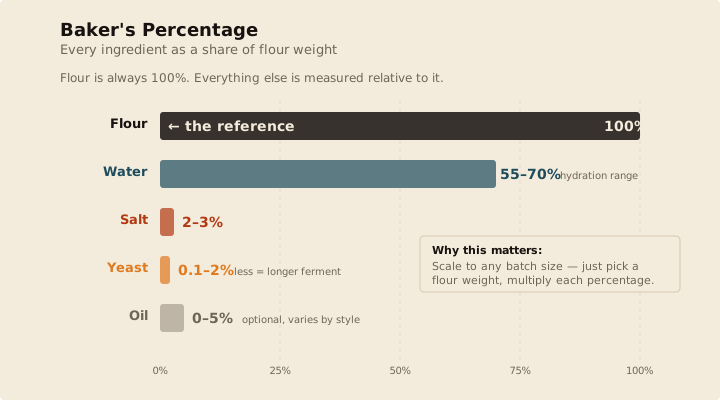
The consequence worth internalising: you cannot work out your flour weight by looking at hydration. You have to invert the whole recipe. Our pizza dough calculator does that arithmetic and shows its working.
Why wetter is not better
More water does two things, and only one of them is good.
The good one: water lets gluten move. A wetter dough develops a looser, more extensible structure, traps larger and more irregular gas bubbles, and bakes into the open crumb people mean when they say a crust looks alive.
The bad one: a wetter dough is slacker. It spreads instead of holding shape, it sticks to the peel, and it punishes hesitation. The gap between a 60% dough and a 75% dough is not a small increment in skill — it is a different handling technique.
There is a third effect people rarely mention. Water is also what the bake has to drive off. A wet dough in a slow oven does not stay wet and open; it spends twenty minutes drying out and comes out tough. Which leads to the part most recipes skip.
Your oven decides how far you can push it
This is the constraint that makes a hydration number meaningful or meaningless.
A gas oven like the Ooni Koda 16 is rated by Ooni to 950°F. At that heat a Neapolitan base is set in 60–90 seconds. A wet dough hits that floor, flashes its water into steam, and puffs before it has any chance to dry. High hydration works because the bake is over almost immediately.
An electric oven changes the maths. Ooni publishes 850°F for the Volt 2 — a hundred degrees lower, and that hundred degrees is roughly the difference between a 60-second bake and a 90-second one. Still fast, but less forgiving of a very slack dough.
A domestic kitchen oven at 500°F is a different problem entirely. The bake runs for minutes, not seconds, and every one of those minutes is evaporating the water you carefully added. This is why high-hydration recipes that work beautifully in a dedicated oven produce disappointing, leathery results indoors.
What the styles actually use
These are conventions, not laws. Treat them as starting points.
| Style | Typical hydration | Why |
|---|---|---|
| Neapolitan | 55–62% | Very hot, very fast bake; dough stays soft |
| New York | 60–65% | Longer bake, oil in the dough, foldable |
| Roman teglia | 75–85% | Baked in a tray, handled wet, very open |
| Detroit pan | 68–72% | Pan-baked, wants an airy interior |
| Gluten-Free | 70–85% | Requires high moisture + hydrocolloid binders to avoid crumbling |
The Neapolitan figure is the one with a published source behind it rather than custom. The AVPN disciplinare gives 1 litre of water to 1.6–1.8kg of flour, which is 56–62% hydration — so the specification's own range is essentially the whole band in that row, not a single number. Take the middle of it and you are at about 57%, which is where our Neapolitan dough recipe sits.
A Note on Gluten-Free Pizza Dough Hydration
Gluten-free pizza dough operates on completely distinct starch chemistry. Without wheat gliadin and glutenin proteins to develop an elastic network, gluten-free flour blends (rice flour, tapioca starch, potato starch) require significantly higher water ratios (70% to 85%) alongside binder hydrocolloids like xanthan gum or psyllium husk. Because gluten-free starches gelatinize and brown differently under high oven temperatures, see tested gluten-free pizza dough formulations and baking methods for exact par-baking ratios and temperature management.
Where to start, and how to move
If you are new to this, start at 60% whatever style you are aiming at. It is forgiving, it shapes predictably, and it will tell you more about your flour and your oven than a wetter dough will, because fewer things go wrong at once.
Then move in 2% steps, changing one variable at a time. Hydration interacts with flour strength, fermentation time and bake temperature, and if you change two together you learn nothing from the result.
Keep a note of what you did. The reason experienced pizza makers seem to know their number is not intuition — it is that they wrote it down.
Gear mentioned

Ooni Koda 16
Gas-only and deliberately simple. Turn it on, wait, cook — no fire to manage.
- Max temperature
- 950°F (500°C)
- Max pizza size
- 16 in
- Stone thickness
- 0.6 in (15 mm) cordierite

Ooni Volt 2
Electric, and the only one here you can legitimately run indoors on a normal socket.
- Max temperature
- 850°F
- Temperature range
- 70–850°F
- Max pizza size
- 12 in
Common questions
- What does 65% hydration mean?
- It means the water weighs 65% of what the flour weighs. For 1,000g of flour that is 650g of water. Hydration says nothing about the total batch size — it is a ratio, which is why the same percentage scales from one pizza to fifty without changing the dough.
- Does higher hydration make better pizza?
- No, it makes different pizza. More water gives a more open, irregular crumb and a lighter texture, but the dough is slacker, harder to shape, and less forgiving of a slow bake. A well-made 60% dough beats a badly handled 75% one every time.
- Why does my high-hydration dough stick to everything?
- Because there is more free water than the flour can hold. Two things help more than adding flour: a stronger flour with higher protein, which absorbs more water, and wet hands rather than floured ones when shaping. Adding dry flour at the shaping stage just lowers your hydration.
- Does oven temperature change what hydration I should use?
- Yes, and it is the constraint most recipes leave out. A very hot oven sets the crust in 60–90 seconds, so a wet dough puffs before it can dry. A domestic oven bakes for far longer, and that same wet dough spends the extra time losing water and going tough.
Sources
Every figure on this page came from one of these. We have not tested this equipment ourselves — how we research.
Compared elsewhere
Ooni Koda 16 vs Ooni Volt 2
Also covers the Ooni Koda 16 and the Ooni Volt 2.
New York Style Pizza Dough
Also covers the Ooni Volt 2 and the Ooni Koda 16.
The Best Outdoor Pizza Ovens, Compared on Published Specs
Also covers the Ooni Koda 16 and the Ooni Volt 2.
Gozney Arc XL vs Ooni Koda 16
Also covers the Ooni Koda 16.