Guide
Why Brisket Stalls, and What to Do About It
Mike Ross · How we research · Updated 2026-08-28 · 4 min read
What is actually happening
You put a brisket on at 225°F. The internal temperature climbs steadily for two or three hours, reaches about 150°F, and then simply stops. Not slows — stops. It can sit there for six hours while you lose faith in your thermometer, your smoker and yourself.
Nothing is broken. The meat is sweating.
Meat is roughly two-thirds water. As it warms, that water migrates to the surface and evaporates, and evaporation takes energy — the same reason sweat cools you and a wet towel on a hot day feels cold. At some point the energy leaving as water vapour equals the energy arriving from the fire, and the temperature flattens out.
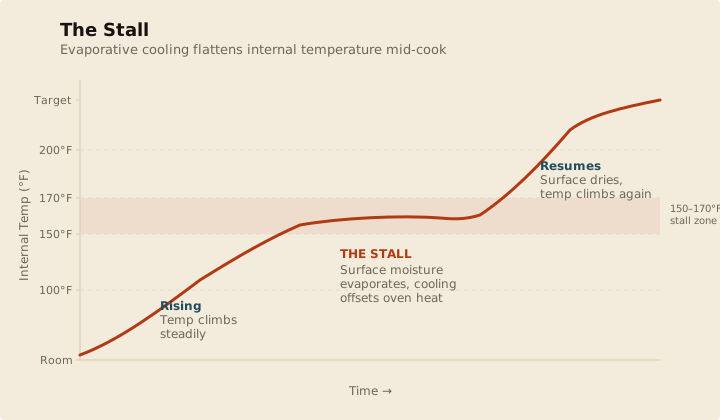
The plateau ends when the surface finally dries out enough that evaporation slows below the rate the fire supplies heat. Then the climb resumes.
How this was established
This is not folklore, which is unusual for barbecue.
Food scientist Greg Blonder ran controlled experiments and published the results. In his test the stall began after two to three hours, when the internal temperature hit about 150°F, and lasted roughly six hours before the temperature began rising again.
The two explanations that turned out to be wrong
Both are still repeated confidently, which is why they are worth naming.
Rendering fat. The intuition is that melting fat absorbs energy. Blonder tested it directly: a lump of pure beef fat, probe inserted, into a thermostatically controlled smoker. It produced a deep pool of melted fat and no comparable stall. As AmazingRibs puts it, the rendering-fat hypothesis is busted.
Collagen conversion. More plausible, because collagen does convert to gelatin around 160°F — right where the stall appears. But the arithmetic does not support it. Collagen is only about 2% of the meat, and the energy needed to convert that much is far less than the energy the stall consumes.
Two things happening at the same temperature is not one thing causing the other.
What to do about it
Three options, and the right one depends on what you are optimising for.
Wait. The stall ends on its own. If you started early enough this costs nothing but nerve, and you keep the best bark, because the surface has spent those hours drying and setting.
Wrap in foil — the Texas crutch. Foil takes the humidity around the meat to near 100%, and with nowhere for moisture to evaporate to, evaporative cooling stops. You power straight through. The cost is the bark: the moisture that would have left is now sitting against your crust, softening it.
Wrap in butcher paper. The compromise. Paper breathes, so it slows evaporation without eliminating it — less time saved than foil, more bark kept.
The practical version
Start earlier than you think you need to. Finished barbecue holds for hours in a cooler; a brisket still stalled at dinner time cannot be hurried.
And when the temperature flatlines at 155°F, do not raise the smoker temperature. You will drive more moisture to the surface, which is the thing cooling the meat in the first place.
"Earlier than you think" has a number attached to it. For a 12 lb brisket at 225°F that is 28 hours from lighting to serving, which puts the fire on the previous afternoon. An 8 lb pork shoulder — the other cut that stalls hard — is 18 hours. Both of those windows exist because of what this page describes.
Gear mentioned

Bryco Goods Pink Butcher Paper
The wrap that breathes. Cuts the stall short without softening bark the way foil does.
- Material
- 100% food-grade certified, unbleached, unwaxed and uncoated
- Coating
- None — unwaxed and uncoated

Alpha Grillers Instant Read Thermometer
The cheapest way to stop guessing. Every temperature on this site assumes you can actually measure one.
- Response time
- 1–2 seconds
- Calibration
- Pre-calibrated, with recalibration available
Common questions
- At what temperature does the stall happen?
- Anywhere between 150°F and 170°F. AmazingRibs notes the exact point depends on the cut's size, shape, surface texture and moisture, on the cooker's airflow and humidity, and on how accurate your thermometer is. In Blonder's test it began around 150°F after two to three hours.
- How long does the stall last?
- In Blonder's controlled test, about six hours before the temperature began rising again. That is why cook-time estimates for brisket are given as wide ranges: the stall is the single largest source of variation in a long cook.
- Should I wrap to beat the stall?
- Wrapping in foil raises the humidity around the meat to near 100%, which stops evaporative cooling and lets you power through. It costs you bark, because the same moisture that would have evaporated now sits against the crust. Butcher paper is the compromise — it breathes.
- Is the stall caused by fat rendering?
- No, and this was tested directly. Blonder put a lump of pure beef fat in a thermostatically controlled smoker; it produced a pool of melted fat with no equivalent stall. AmazingRibs states plainly that the stall "has nothing to do with fat or collagen".
Sources
Every figure on this page came from one of these. We have not tested this equipment ourselves — how we research.
Compared elsewhere
Alpha Grillers vs ThermoWorks ThermoPop 2
Also covers the Alpha Grillers Instant Read Thermometer.
ThermoWorks Thermapen ONE vs Alpha Grillers Instant Read
Also covers the Alpha Grillers Instant Read Thermometer.
How to Smoke a Turkey: The USDA Numbers, and When to Start Thawing
Also covers the Alpha Grillers Instant Read Thermometer.
The Celiac Pitmaster: Gluten-Free BBQ and Smoker Safety
Also covers the Bryco Goods Pink Butcher Paper.