Guide
How to Smoke a Ham: Fully Cooked or Not, and the Temperature Each Needs
Mike Ross · How we research · Updated 2026-10-14 · 4 min read
The most important step in smoking a ham happens in the shop, not at the smoker: reading the label. There are two kinds of ham, and they have different finishing temperatures.
Fully cooked, or cook before eating
USDA puts it simply:
- Fully cooked hams packaged in an inspected plant may be eaten cold, or reheated to 140°F.
- Leftover cooked ham, or cooked ham repackaged anywhere outside the plant, must be heated to 165°F.
- Cook-before-eating hams must be cooked to 145°F and rested for at least three minutes.
USDA also notes that some hams are smoked after curing. Putting a fully cooked, already-smoked ham in your smoker is reheating it with extra smoke, which is what people mean by a double-smoked ham. The label tells you which you have.
Spiral-cut hams are a special case: USDA says they are safe cold and best served cold, because heating the slices can dry them out.
The published times
USDA's holiday roasting chart, in an oven at 325°F:
| Ham | Oven at 325°F | Target |
|---|---|---|
| Fully cooked, bone-in, whole, 14–16 lb | 15–18 min/lb | 140°F |
| Fully cooked, bone-in, half, 7–8 lb | 18–25 min/lb | 140°F |
| Fully cooked, boneless, 3–4 lb | 27–33 min/lb | 140°F |
| Cook-before-eating, bone-in, whole, 14–16 lb | 18–20 min/lb | 145°F, rest 3 min |
| Cook-before-eating, bone-in, half, 7–8 lb | 22–25 min/lb | 145°F, rest 3 min |
Country hams, which are dried, are different again: USDA says follow the label.
Turned into hours for the common sizes, by our arithmetic from those rates:
| Fully cooked ham | At 325°F |
|---|---|
| Boneless, 3 lb | 1h 21m–1h 39m |
| Boneless, 4 lb | 1h 48m–2h 12m |
| Bone-in half, 7 lb | 2h 6m–2h 55m |
| Bone-in half, 8 lb | 2h 24m–3h 20m |
| Bone-in whole, 14 lb | 3h 30m–4h 12m |
| Bone-in whole, 16 lb | 4h–4h 48m |
What changes in a smoker
That table is for an oven at 325°F. USDA's smoking guidance is a separate document, and it says to hold the smoker's air between 225 and 300°F.
- If your smoker holds 325°F, the table is the closest published reference. Using it for a smoker is our inference, not USDA's.
- At 225 to 275°F a ham takes longer, and nobody publishes how much longer for ham, so this page does not print a number.
On a fully cooked ham that is low-stakes: you are only bringing it to 140°F. On a cook-before-eating ham, it is the reason to use a thermometer, not the clock.
Two thermometers
USDA asks for one in the smoker's air and one in the meat. Put the meat probe in the thickest part, not touching the bone. A leave-in probe with an alarm means you are not opening the lid to check.
Glaze last
USDA's smoking advice is to put sauce on in the last 15 to 30 minutes, so it does not brown too much or burn. A ham glaze is mostly sugar, which is exactly the problem, so the same rule applies.
Wood
Ham is pork that has usually been smoked already, so it does not need much more. Hickory is the traditional ham smoke; fruit woods are milder. Which wood does what.
Afterwards
USDA says refrigerate anything coming off the smoker within 2 hours. Its ham storage chart gives spiral-cut ham and leftovers from a ham you cooked 3 to 5 days in the refrigerator, or 1 to 2 months frozen.
Planning the day
Work backwards from dinner with the long end of the table, plus time for the smoker to settle and the glaze at the end. Doing beef as well? How to smoke a prime rib has the USDA rib roast table, and how to smoke a turkey the bird.
Gear mentioned

ThermoWorks Signals 4-Channel BBQ Alarm
Four-channel standalone WiFi and Bluetooth BBQ temperature monitor with commercial accuracy and real-time cloud graphing.
- Channels
- 4 simultaneous channels (3 Pro-Series meat probes + 1 high-temp air probe)
- Connectivity
- Simultaneous Wi-Fi and Bluetooth wireless technology
- Accuracy
- ±1.8°F (±1.0°C) from -58 to 392°F; ±3.6°F above 392°F
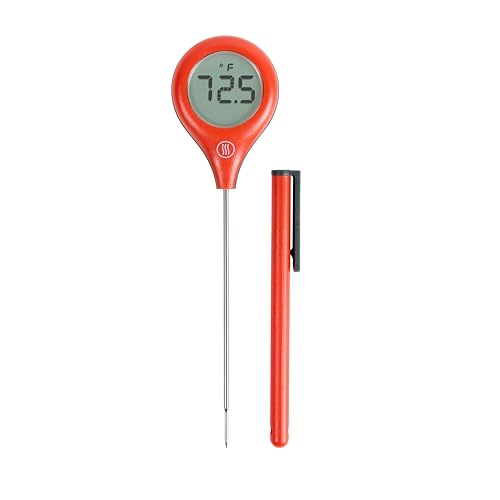
ThermoWorks ThermoPop 2
The middle of the thermometer ladder. Publishes its accuracy like the Thermapen, at a fraction of it.
- Accuracy
- ±1°F in key cooking ranges
- Response time
- 2-3 seconds
- Calibration
- NIST-traceable certificate included

Bear Mountain Hickory BBQ Pellets
Hardwood pellets with nothing else in them. The default fuel for any pellet grill.
- Wood
- 100% hardwood, hickory over an alder or oak base
- Bag sizes
- 20 lb and 40 lb
- Additives
- No flavourings, fillers or additives
Common questions
- What temperature do you smoke a ham to?
- It depends on the label. USDA says a fully cooked ham packaged in an inspected plant can be eaten cold or reheated to 140°F. Leftover ham, or cooked ham repackaged anywhere outside the plant, must be heated to 165°F. A cook-before-eating ham must reach 145°F and rest for at least three minutes.
- How long does it take to smoke a fully cooked ham?
- USDA publishes oven times at 325°F: 15 to 18 minutes a pound for a whole bone-in ham of 14 to 16 lb, 18 to 25 for a 7 to 8 lb half, and 27 to 33 for a 3 to 4 lb boneless ham. A smoker at 325°F follows that closely. At 225 to 275°F it takes longer, and nobody publishes by how much.
- What is a double-smoked ham?
- A ham that was smoked after curing and goes in the smoker again at home. USDA notes that some hams are smoked after curing; the label says whether yours was. If it is fully cooked and plant-packaged, the second smoke is for flavour and warmth, and the target is USDA's 140°F reheating temperature.
- Can you smoke a spiral-cut ham?
- Yes, but USDA says spiral-cut cooked hams are safe to eat cold and are best served cold, because heating the slices can dry them out. If you reheat one packaged at the plant, the target is 140°F; leftover spiral-cut ham must reach 165°F.
- When do you put glaze on a smoked ham?
- Late. USDA's smoking guidance says to apply sauce in the last 15 to 30 minutes, to prevent excess browning or burning, and a sugary glaze is the same problem.
- How long does leftover ham keep?
- USDA says spiral-cut ham and leftovers from a ham you cooked keep 3 to 5 days in the refrigerator, or 1 to 2 months frozen. Refrigerate anything coming off the smoker within 2 hours.
Sources
Every figure on this page came from one of these. We have not tested this equipment ourselves — how we research.
Compared elsewhere
BBQ Gifts Worth Giving, Sorted by What They Already Own
Also covers the ThermoWorks ThermoPop 2, the ThermoWorks Signals 4-Channel BBQ Alarm and 1 more of the same products.
How to Smoke a Turkey: The USDA Numbers, and When to Start Thawing
Also covers the ThermoWorks Signals 4-Channel BBQ Alarm and the Bear Mountain Hickory BBQ Pellets.
Alpha Grillers vs ThermoWorks ThermoPop 2
Also covers the ThermoWorks ThermoPop 2.
ThermoWorks Signals vs MEATER Pro 2 Plus
Also covers the ThermoWorks Signals 4-Channel BBQ Alarm.