Guide
How Much Fuel Does a Smoke Actually Use?
Mike Ross · How we research · Updated 2026-08-30 · 5 min read
The number nobody gives you before you buy the smoker
Fuel is the cost that keeps arriving. The cooker is bought once; the bags are bought forever, and almost nobody tells you the rate before you commit.
Here is the honest version, split into the part we can compute and the part we refuse to guess at.
Pellets: computable, and the answer is more than you think
No pellet grill maker publishes a consumption rate, so these are the conventional figures:
| Smoker temperature | Pellets per hour |
|---|---|
| 225°F | 0.75–1.25 lb |
| 250°F | 1–1.5 lb |
| 275°F | 1.25–1.75 lb |
| 325°F | 1.75–2.5 lb |
Multiply that by a cook time and you get the figure that actually matters. These come from the same arithmetic behind our cook-time pages, so they move if the charts move.
| Cook | Time | Pellets | 20 lb bags |
|---|---|---|---|
| Whole chicken, 4 lb, 325°F | 1h36m–2h24m | 2.8–6 lb | 1 |
| Baby back ribs, 275°F | 3–4h | 3.8–7 lb | 1 |
| Spare ribs, 275°F | 3h30m–4h30m | 4.4–7.9 lb | 1 |
| Beef short ribs, 4 lb, 250°F | 5–7h | 5–10.5 lb | 1 |
| Turkey, 14 lb, 325°F | 4h54m–7h | 8.6–17.5 lb | 1 |
| Pork shoulder, 8 lb, 275°F | 8–10h | 10–17.5 lb | 1 |
| Pork shoulder, 8 lb, 225°F | 12–16h | 9–20 lb | 1 |
| Brisket, 12 lb, 225°F | 18–24h | 13.5–30 lb | 2 |
| Brisket, 18 lb, 225°F | 27–36h | 20.3–45 lb | 3 |
Hotter is not more expensive
The intuition says a hotter cook burns more fuel. Per hour it does — consumption roughly doubles from 225°F to 325°F. Per cook it usually does not, because the cook gets shorter faster than the rate rises.
The 8 lb pork shoulder in that table is the clean demonstration. At 225°F it is 9–20 lb over 12–16 hours. At 275°F it is 10–17.5 lb over 8–10 hours — a tighter range, in a bit over half the time.
So running hotter is not a fuel decision. It is a bark-and-schedule decision, and the fuel comes out roughly level either way.
Why the ranges are so wide
Because each figure is two ranges multiplied together: the cook time is a range, and the consumption rate is a range.
The low end of "13.5–30 lb" is the fast cook running at the low rate. The high end is the slow cook at the high rate. Both happening at once is unlikely, so the truth sits nearer the middle — but you buy fuel against the top, because running out is the only outcome that ruins the cook.
Cold weather and wind push you toward the high end. So does opening the lid.
Charcoal: we will not give you a number
Every site that tells you "you need 8 lb of charcoal for a brisket" has invented it. Here is why nobody can honestly do that arithmetic.
Charcoal burns at the rate the fire is fed air, and the air depends on the cooker, the vents, the weather and you. The manufacturers' own figures make the point better than we can: Jealous Devil publishes 4+ hours for open-air grilling and 20+ hours in a smoker for the same charcoal in the same bag.
That is a five-fold spread from one variable — how choked the fire is. Add firebox size, wind, ambient temperature and lid discipline, and any single number is a guess wearing a lab coat.
Wood chunks last far longer than either
Chunks are not the heat source. They are the smoke, sitting on top of a fire made of something else, so you are using three or four per cook rather than filling a basket.
Weber publishes 350 cubic inches for a bag of hickory chunks, which is a volume rather than a weight — and volume is the right unit here, because you buy chunks by the handful and not by the hour.
A bag lasts many cooks. It is the one fuel line that does not really need budgeting.
What this means when you buy
Pellet grill: buy in 40 lb rather than 20 lb if your supplier offers it, and keep a spare bag. The hopper is not the constraint — the cook is. A 20 lb hopper with a 30 lb cook in front of it needs refilling at some point, and the point is usually the middle of the night.
Charcoal: buy more than you think and stop trying to compute it. Leftover charcoal keeps indefinitely if it stays dry, so over-buying costs nothing but shelf space.
Chunks: one bag, and stop thinking about it.
For what to put in the hopper or basket in the first place, our fuel comparison covers what each brand publishes and what it does not. To work out the cook time these figures multiply against, the smoker calculator takes your cut and weight and gives you the window — and the pellet estimate alongside it.
Gear mentioned

Bear Mountain Hickory BBQ Pellets
Hardwood pellets with nothing else in them. The default fuel for any pellet grill.
- Wood
- 100% hardwood, hickory over an alder or oak base
- Bag sizes
- 20 lb and 40 lb
- Additives
- No flavourings, fillers or additives

Jealous Devil Chunx XL Lump Charcoal
Dense South American hardwood in large pieces. The one to reach for when the cook runs long.
- Wood
- Responsibly harvested South American hardwood
- Burn time
- 4+ hours open-air, 20+ hours in a smoker
- Peak temperature
- Over 1,170°F
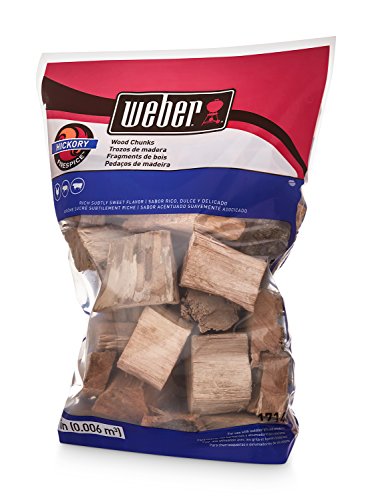
Weber Hickory Wood Chunks
Smoke, not heat. Chunks go on top of charcoal to turn a grill into a smoker.
- Wood
- Hickory
- Volume
- 350 cu in (0.006 m³)
Common questions
- How many pellets for a brisket?
- A 12 lb brisket at 225°F is an 18 to 24 hour cook, which at conventional consumption rates burns 13.5 to 30 lb of pellets. Buy two 20 lb bags. An 18 lb brisket at the same temperature runs 20 to 45 lb, which is three.
- Does a hotter smoker use more pellets?
- Per hour yes, per cook usually no. Consumption roughly doubles between 225°F and 325°F, but the cook gets shorter by more than that. An 8 lb pork shoulder uses 9 to 20 lb at 225°F and 10 to 17.5 lb at 275°F — a narrower range in less than half the time.
- How much charcoal do I need?
- Nobody can tell you honestly. Consumption depends on how much air your cooker pulls, which varies with firebox size, vent position, wind and how often you open the lid. The manufacturers publish burn times that differ by a factor of five between an open grill and a choked-down smoker.
- Why is the pellet range so wide?
- Because it is two ranges multiplied together. The cook time is a range and the consumption rate is a range, so the low end is the fast cook at the low rate and the high end is the slow cook at the high rate. The true figure is almost always in the middle.
- Can I run out mid-cook?
- On a 20 lb hopper doing a long brisket, yes. That is the whole reason this page exists — a single overnight cook can exceed one bag, and a hopper that empties at 3am stalls the cook until you notice.
Sources
Every figure on this page came from one of these. We have not tested this equipment ourselves — how we research.
Compared elsewhere
Pellets, Lump, Briquettes or Chunks? Choosing BBQ Fuel
Also covers the Bear Mountain Hickory BBQ Pellets, the Jealous Devil Chunx XL Lump Charcoal and 1 more of the same products.
Smoking Wood Flavor Chart: Hardwood Profiles and Meat Pairings
Also covers the Bear Mountain Hickory BBQ Pellets and the Weber Hickory Wood Chunks.
BBQ Gifts Worth Giving, Sorted by What They Already Own
Also covers the Jealous Devil Chunx XL Lump Charcoal and the Bear Mountain Hickory BBQ Pellets.
Lump Charcoal vs Briquettes
Also covers the Jealous Devil Chunx XL Lump Charcoal.